A Gallery Visit Built Around One Question
A gallery visit built around one question helps you notice connections, handle distractions, and leave with a record of what the exhibits do not resolve.
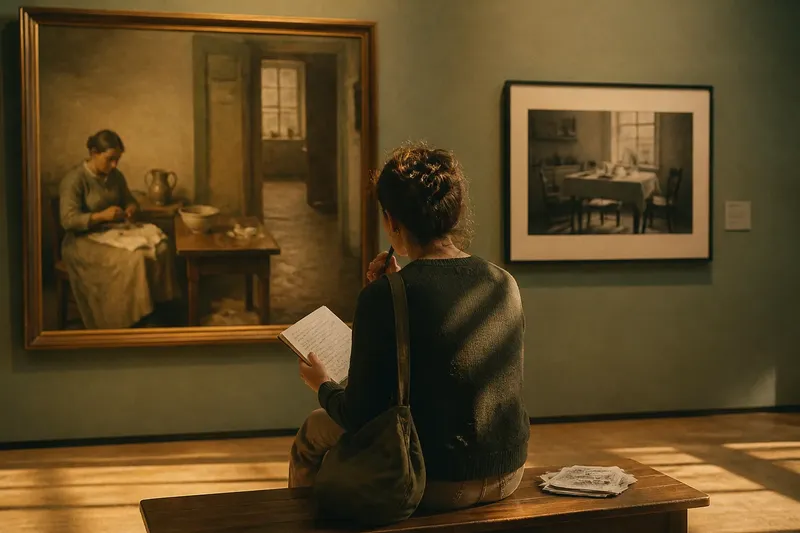
The common mistake on a gallery visit is trying to see everything; the cost is a blur of labels and images with little left to think about afterward. A gallery visit built around one question gives your attention a job: notice what the exhibits help you answer, and what they leave open.
The question should be narrow enough to guide your eyes but roomy enough for several works to answer differently. You do not need specialist knowledge or a perfect interpretation. You need a prompt you can carry from room to room, plus a way to record observations without turning the visit into a research assignment.
Choose a workable question
Pick a question before entering, while you still have time to notice what draws you to the exhibition. It might concern a visible choice, such as how artists represent distance, work, care, power, or a changing landscape. Avoid questions that require you to know an entire period or settle a broad argument.
A useful question invites comparison. “How do these artists show who belongs?” can lead you to look at figures, spaces, gestures, and omissions. “What is art?” usually gives you no practical instruction for looking. If the exhibition’s title suggests a topic, you can use it as a starting point without assuming every object will address it in the same way.
Make the question easy to remember. Write it in a phone note or on a small card, then add one sentence about why you chose it. That sentence can help you distinguish your own interest from a theme you think the exhibition expects you to find.
Let the exhibits answer
Once inside, resist the urge to read every wall panel before looking. Choose a work that catches your attention, pause, and describe what you can actually see. Note details such as scale, material, placement, repeated shapes, or the direction a figure faces. Then ask how those details bear on your question.
Separate observation from interpretation in your notes. “A narrow doorway is painted behind the seated figure” is an observation; “the figure is being excluded” is an interpretation. Both can be useful, but keeping them distinct makes it easier to change your mind when another work complicates the first reading.
Move on when you have something to compare, not when you have exhausted a single object. A second work might echo the same idea with different materials, or contradict it. Notice the contrast rather than forcing both works into one answer.
When the prompt stalls
What if the question feels too broad?
Attach it to something observable. Instead of asking what the exhibition says about identity, ask how portraits use clothing or posture to suggest identity. The revised prompt gives you details to look for while leaving room for different interpretations.
What if a work seems unrelated?
Give it a brief look without demanding a connection. It may offer a counterexample, or it may simply not serve your question; record that distinction and continue. A focused visit does not require every object to fit the same argument.
What if the answer seems obvious?
Ask what the work makes difficult, leaves out, or presents differently from the previous one. A quick answer can be a useful starting point, but comparison often reveals the conditions or exceptions that the first impression missed.
What if you feel pressure to sound informed?
Write what you notice in ordinary language and mark uncertainty plainly. You can ask a gallery attendant about a label or context if it would help, but you do not need to turn an impression into a confident claim.
Handle common distractions
Some visits become frustrating because the question is treated as a rule rather than a guide. If you catch yourself hunting only for evidence that confirms your first idea, widen the prompt or add a second possibility. “How does this work invite belonging, and what might make that invitation conditional?” keeps attention alert to tension instead of requiring a single verdict.
Other distractions are practical. A crowded room can make close looking difficult; step aside, return when there is space, or choose a work you can see clearly from where you are. If fatigue is setting in, take a short pause rather than racing through the remaining rooms. The question is there to help you choose where to spend attention, not to demand a complete tour.
Say you enter a show about domestic life wondering how artists make ordinary labor visible. In one painting, you notice a figure’s hands and the tools arranged nearby; in a photograph, you notice that the room is empty but still marked by use. Your notes might say that one work shows labor through an action, while the other suggests it through traces. That is a useful comparison, even if neither work settles what counts as labor.
What is not worth the effort: copying long label text or trying to attach a theory to every object. If a label offers context that changes your reading, write down the short point that matters. Leave the rest for another visit or a later lookup.
Record what remains open
Before leaving, review your notes and mark three kinds of material: a detail you can point to, an interpretation you considered, and a question that remains unresolved. This small distinction keeps memory from turning a tentative thought into a fact about the work or the artist.
For the unresolved question, be specific. “Why is this figure absent?” may be a useful prompt if the work gives you a reason to ask it; “What does the whole exhibition mean?” is too large to carry forward. You can also note what evidence would help: another work in the show, a label, a source about the materials, or a conversation with someone who noticed something different.
If the visit is with another person, compare notes after looking rather than deciding in advance what you should both see. Ask which detail changed each person’s reading. Different answers do not need to be reconciled; they can show how a work supports several readings or where a disagreement rests on different observations.
Questions after a visit?
How many works should I focus on?
There is no fixed count. Follow the question through enough works to notice a comparison, then stop when your attention fades or the exhibition no longer adds a useful angle.
Should I read every wall label?
No. Look first, then read labels when context could clarify a material, subject, or decision. Note the part that affects your interpretation instead of copying the whole text.
Can I use the same question for another gallery?
Yes, if the new exhibition gives you something concrete to examine. Keep the wording flexible: the same question may lead to a different set of observations in another collection.
What should I do with unanswered questions?
Keep one or two in your notes and identify what might help address them. You can look for relevant gallery information later, ask a knowledgeable person, or leave the uncertainty intact when the evidence is not there.
Leave with a useful note
End with a brief record in your own words: the question you brought, the detail that most changed your thinking, and what you still cannot explain. Add the name of the work or room if you want to find it again. This gives a later search or conversation a clear starting point without pretending the visit produced a final answer.
A gallery visit built around one question works best when the question remains open to correction. Keep it visible, let particular works complicate it, and record the unresolved part accurately. The next time you return to a familiar exhibition—or enter a new one—you will have a more useful habit than trying to remember everything you saw.